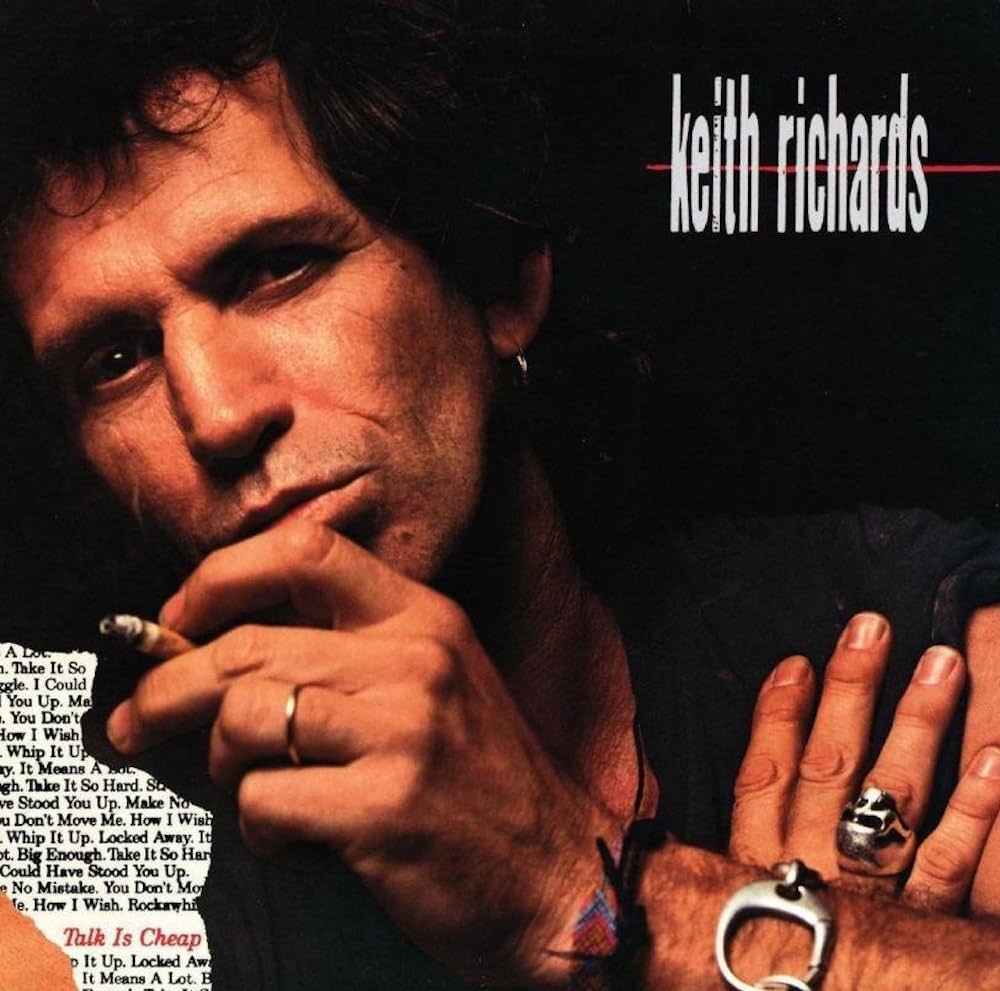
Was Keith Richards’ first solo record, Talk is Cheap, the best Rolling Stones album of the 1980s? I certainly thought so when it first came out back in October of 1988, and there is still a good argument to be made on that front 36 years later.
The funny thing, of course, is that Keith would never have done this record in the first place if he had his way.
Hard as it may be to believe now, there was a period there in the mid-to-late 80s where it looked like The Rolling Stones might break up for good. The reasons why have been well-documented over the years, but the short version is that Mick and Keith were not getting on because of their divergent views on the direction of the band. Mick wanted to chase trends to stay relevant in the MTV era; Keith wanted to stay true to the Stones’ roots. But, Mick was also maybe a little bored with the band, and wanted to try his hand at going solo. For Keith, that idea was anathema. The band comes first, or there is no band. When Mick chose to focus on his solo career instead of doing a Stones tour to support their Dirty Work album in 1986, Keith followed suit, and the future of the band seemed to be in jeopardy.
But, out of that discord came a terrific album that gave Keith a much-needed shot in the arm, and highlighted all of his strengths.
To start, Talk is Cheap is a total groove record. All of the songs lock into a groove that is hypnotic, organic, and fun. You can bob your head, stomp your leg, and sway your hips to these tunes. Keith’s love of R&B and the blues is evident here, and It is easy to imagine many of these tracks coming out of a jam session and being honed from there.
This record also rocks and rolls, as befits a core member of the Stones. Which is to say that Talk is Cheap is more rootsy (and, dare I say, more relevant) than anything the Stones released that entire decade. Don’t get me wrong: the 80s gave us at least one classic Stones album (Tattoo You), one underrated sleeper (Undercover), and one massively overrated record from them (Steel Wheels). But, what all of those efforts have in common is an aggressive professionalism that gives one the impression that the band may have focused more on staying busy than making sure their fans had something fun to listen to. That’s where Talk is Cheap triumphs: it is fun. It sounds looser and boozier than the Stones had sounded in a while – and, it also sounds like Keith is actually enjoying himself. Is it any wonder, then, that Stones fans treated this one like a drink of water after being lost in the desert upon first hearing it?
Also: can we talk about Keith’s band for a minute? He did not just hire a bunch of random session players for a one-off job. Instead, he recruited an all-star team of the best musicians in the business (appropriately named The X-Pensive Winos, by the way), and they became his official band for all of his subsequent solo albums. Led by Keith’s co-producer and second-in-command, drummer Steve Jordan, the Winos features Sarah Dash on backing vocals (she was one-third of the legendary funk/soul group Labelle), multi-instrumentalist Charley Drayton, keyboardist Ivan Neville, saxophonist Bobby Keys (a core member of the Stones touring band for many years), and guitarist Waddy Wachtel, and they have instant, undeniable chemistry throughout Talk is Cheap. Keith’s shaggier, relaxed approach suits them perfectly, and they take to it like…well, like a unit that had already been playing together as long as the Stones had. Throw in a couple of musical guest spots by folks like Chuck Berry’s longtime piano player, Johnnie Johnson, and Parliament-Funkadelic alums Bootsy Collins, Maceo Parker, and Bernie Worrell, and you get an idea of what Keith is up to here.
As for the songs themselves, it is not a surprise that they sound a lot like the Stones. What is surprising is how different they are from the Stones because Mick is not involved. Keith co-wrote everything on Talk is Cheap with Steve Jordan, and having a new (and younger) writing partner results in an album that, in my view, sounds like what the Stones would be if Keith were totally in charge. There are jagged uptempo numbers like “Take it So Hard” (the lead single), “How I Wish,” and “Whip it Up.” There is the obligatory Chuck Berry homage, “I Could Have Stood You Up.” There are mid-tempo shufflers like “Rockawhile.” And there is a surprisingly catchy ballad, “Locked Away.” Most notably, there is Keith’s snide takedown of Mick, “You Don’t Move Me,” which features bon mots like “Why do you think you got no friends / You drove them around the bend.” In all, Talk is Cheap runs a wider gamut of emotional colors than the Stones typically do. It is defiant, bitchy, breezy, vulnerable, and warm. Those last two really stand out here because no one would ever accuse the Stones albums of the ‘80s of being either vulnerable or warm.
Mick’s solo debut may have sold better than Keith’s did (She’s the Boss went Platinum; Talk is Cheap went Gold), but Keith won the PR war. He made people interested in the Stones again because he reminded them that someone in that band could still make an album as good as Talk is Cheap. For a guy who had always put the band first, Keith showed Mick how to do a proper solo album.
The rest was history. Within a year, Keith and Mick resolved their differences, and the Stones released Steel Wheels, which was hailed as a major return to form and completed their transformation into fine purveyors of polished corporate dad rock. But, by then, we all knew the truth. Mick is the savvy CFO of the band, with a sharp eye for their public image. Keith, on the other hand, is the heart and soul of the Rolling Stones. Talk is Cheap proved that.
:format(jpeg):mode_rgb():quality(90)/discogs-images/R-745229-1481752948-3777.png.jpg)
 Strictly Back Catalogue